
Stem Cells Translational Medicine, 05/08/2026
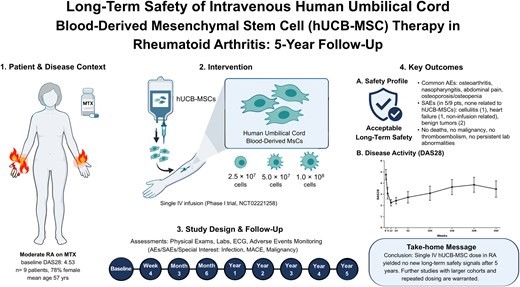
Introduction
Rheumatoid arthritis (RA) is a chronic systemic inflammatory disease that causes synovial inflammation and can lead to joint destruction and disability. Biologic disease-modifying antirheumatic drugs (bDMARDs) and targeted synthetic disease-modifying antirheumatic drugs (tsDMARDs) have improved the efficacy of RA treatment but increase the risk of infections and certain adverse events: TNF-α inhibition is associated with tuberculosis and non-melanoma skin cancer, rituximab is associated with hepatitis B, while JAK inhibitors increase the risk of herpes zoster and may increase the risk of malignancy.
Therefore, MSC therapy is being investigated as a potential treatment approach due to its tissue regenerative and immunomodulatory properties, through inhibition of immune cell activation, reduction of T/B cell proliferation, promotion of M2 macrophages, and increase in Tregs.
Human umbilical cord blood-derived MSCs (hUCB-MSCs) have the advantages of non-invasive collection, high proliferative capacity, and low immunogenicity. A previous phase 1a study showed that a single intravenous infusion of hUCB-MSCs had an acceptable safety profile after 4 weeks in patients with RA.
However, data on long-term safety remain limited. Therefore, this study evaluated the safety over 5 years following a single intravenous infusion of hUCB-MSCs in patients with RA.
Materials and Methods
Study design and population
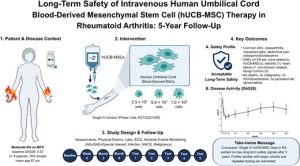
A prospective, observational 5-year study was conducted to follow patients from the CURE-iv trial (NCT02221258), a phase I, open-label, dose-escalation study evaluating the safety and clinical outcomes of intravenous hUCB-MSCs.
Eligibility criteria:
- ≥18 years of age and met the 2010 ACR/EULAR RA classification criteria.
- DAS28 (disease activity score 28) >3.2 despite treatment with methotrexate (MTX).
In CURE-iv, patients received a single intravenous infusion of hUCB-MSCs at a dose of 2.5 × 10⁷, 5 × 10⁷, or 1 × 10⁸ cells. Patients were followed for up to 5 years or until study completion, death, withdrawal of consent, or loss to follow-up. During this period, patients received treatment according to standard medical practice and DMARD use was recorded.
The study was approved by the Ethics Committee and conducted in accordance with Good Clinical Practice and the Declaration of Helsinki; all participants provided written informed consent.
Safety profiles
Primary objective: To evaluate the long-term safety of a single intravenous infusion of hUCB-MSCs over 5 years of follow-up.
- Adverse events (AEs) and serious adverse events (SAEs) were recorded at 3, 6, and 12 months after infusion and annually thereafter.
- SAEs were defined according to FDA criteria, including life-threatening events, events requiring hospitalization, causing significant disability, congenital anomalies, or death.
- AEs of special interest included serious/opportunistic infections, major adverse cardiovascular events (MACEs), thromboembolic events, and malignancies.
- At each follow-up visit, clinical examinations, laboratory tests, and electrocardiography (ECG) were performed.
- Causal relationship assessment: performed by the study physicians based on the timing of event onset, biological plausibility, and other causes such as underlying disease activity and concomitant medications. All events were assessed consistently according to predefined criteria; no independent event adjudication committee was established.
Clinical assessments for disease activity
To assess long-term safety in the clinical context, disease activity was monitored over time using DAS28. At the same time, clinical efficacy and changes in concomitant medications, including bDMARDs and tsDMARDs, were collected from medical records at baseline, week 4, month 3, month 6, and annually up to 5 years after infusion.
Statistical analysis
- Continuous variables were presented as mean ± standard deviation (SD); categorical variables were expressed as frequencies and percentages.
- Laboratory results between baseline and follow-up time points were compared using the paired t-test or Wilcoxon signed-rank test, with Bonferroni correction applied for multiple comparisons.
- Statistical significance: P < 0.05.
Results
Patients
- 9 patients from the CURE-iv trial were included in the long-term safety analysis and completed 5 years of follow-up.
- Each patient received a single intravenous infusion of hUCB-MSCs:
- 5 × 10⁷ cells (n = 3)
- 0 × 10⁷ cells (n = 3)
- 0 × 10⁸ cells (n = 3)
- Mean age: 57.4 ± 10.0 years; 77.8% were female.
- RA duration: 9.5 ± 8.7 years; baseline DAS28-ESR: 4.53 ± 1.35.
- All patients were receiving MTX, with a mean dose of 14.2 mg/week.
- 7 patients were receiving systemic corticosteroids, with a mean dose of 3.1 mg prednisolone/day or equivalent.
- None of the patients had previously received biologic DMARDs.
Summary of Aes
Over the 5-year period, 97 AEs were recorded across all patients.
- The most common AEs were:
- Osteoarthritis: 4 patients (44.4%)
- Nasopharyngitis: 4 (44.4%)
- Abdominal pain/discomfort: 3 (33.3%)
- Osteoporosis/osteopenia: 3 (33.3%)
- Lumbar spinal stenosis: 2 (22.2%)
- Hypertension: 2 (22.2%)
- Other AEs were recorded in 1 patient/event.
- 3 patients experienced severe AEs, with each patient belonging to a different hUCB-MSC dose group. No life-threatening AEs or deaths were reported over the 5-year period.
- There were 9 SAEs in 5 patients (55.6%), including cellulitis, compression fracture, limb deformity, lumbar spinal stenosis, colorectal polyp, diabetes mellitus, sinusitis, meniscal injury, and arthralgia.
- None of the SAEs were assessed as related to hUCB-MSC infusion.
AEs of special interests
- One case of serious infection (cellulitis) was recorded in the 1.0 × 10⁸ hUCB-MSCs group and was successfully treated with antibiotics.
- One MACE (heart failure) also occurred in the 1.0 × 10⁸-cell dose group.
- Cellulitis occurred >12 months after infusion in a patient receiving DMARDs; heart failure occurred several years after infusion in a patient with pre-existing hypertension. Given the long interval after infusion and the underlying risk factors, both events were assessed as unlikely to be related to hUCB-MSCs and both resolved without sequelae.
- After 3 years, one benign ovarian tumor was reported in the 2.5 × 10⁷-cell group and one breast adenoma in the 5.0 × 10⁷-cell group.
- During the 5-year follow-up, no opportunistic infections, thromboembolic events, or malignancies were reported.
Occurrence of clinical AEs by organ systems over time
After 1 year following a single intravenous infusion of hUCB-MSCs, the incidence of AEs began to gradually increase over time. Musculoskeletal AEs occurred throughout the follow-up period, while infection-related and gastrointestinal AEs began to be recorded from the first year after hUCB-MSC infusion.
Laboratory parameters
The mean values of laboratory parameters remained stable over the 5 years after hUCB-MSC infusion.
- WBC, absolute neutrophil and lymphocyte counts, hemoglobin, creatinine, total cholesterol, and liver function remained within normal ranges in all patients.
- 1 patient developed elevated triglycerides after 3 months, which subsequently returned to normal without lipid-lowering treatment.
- 1 patient developed eosinophilia after 60 months, but without skin rash or other clinical symptoms.
Long-term disease activity and medication changes
After a single intravenous infusion of hUCB-MSCs, disease activity decreased markedly, reaching its lowest level at approximately 3–6 months:
- DAS28: 4.76 ± 1.38 (baseline) → 2.24 ± 0.91 (month 3).
- Overall clinical improvement was maintained until 1 year after infusion.
- Thereafter, disease activity gradually increased back to baseline levels over the 5-year follow-up, consistent with the chronic nature of RA and the use of only a single dose of hUCB-MSCs.
- 2/9 patients (22.2%) required treatment intensification with bDMARD/tsDMARD to maintain disease control: 1 patient received tocilizumab and 1 patient received tofacitinib.
Discussion
This study provides initial data on the long-term safety of hUCB-MSCs in RA, with a 5-year follow-up period. Over the 5 years, a single intravenous infusion of hUCB-MSCs was generally well tolerated. No serious late events such as opportunistic infections, thromboembolic events, or malignancies were reported. There was 1 case of cellulitis and 1 case of heart failure in the 1.0 × 10⁸-cell group; both resolved without sequelae and were assessed as unrelated to the intervention. No deaths were reported, and laboratory parameters remained stable over the 5 years.
Regarding clinical efficacy, disease activity decreased markedly after infusion, reaching its lowest level at 3–6 months and maintaining improvement until approximately 1 year, after which it gradually returned to baseline levels during the 5-year follow-up period. This is consistent with the chronic course of RA and the use of only a single treatment dose. Overall, the results indicate a favorable short-term benefit–risk profile, but repeated treatment may be required for long-term disease control.
Regarding the mechanism, MSCs exert immunomodulatory effects through increasing Tregs and Tr1 cells, inhibiting Th1/Th17, reducing pro-inflammatory cytokines such as TNF-α, IL-17, IL-4, and IFN-γ, while increasing IL-10 and TGF-β. MSCs also promote the M1 → M2 macrophage transition, inhibit osteoclastogenesis, B-cell activation, and synovial fibroblast activity. The low immunogenicity of hUCB-MSCs, with low expression of MHC II and co-stimulatory molecules, may contribute to the favorable safety profile observed.
Main limitations:
- Small sample size (n = 9), insufficient to assess safety differences between doses or detect rare events.
- Open-label, single-arm design without a control group, preventing definitive determination of causal relationships.
- Only a single infusion was evaluated; repeated infusions may result in a different long-term risk profile.
- Therefore, randomized, controlled phase II/III studies with larger sample sizes, evaluation of multi-dose regimens, and long-term follow-up are needed.
After 5 years of follow-up, a single intravenous infusion of hUCB-MSCs showed an acceptable long-term safety profile in patients with RA, with no serious safety issues clearly related to the therapy reported. However, due to the small sample size and lack of a control group, the results should be interpreted with caution and confirmed in larger, controlled studies using multi-dose regimens.
References
Eun Hye Park, Min Jung Kim, Kyung-Sun Kang, Kichul Shin, Long-term safety of intravenous human umbilical cord blood-derived mesenchymal stem cell therapy in rheumatoid arthritis: a 5-year follow-up study, Stem Cells Translational Medicine, Volume 15, Issue 8, August 2026, szag062
Source: Stem Cells Translational Medicine
Link: https://academic.oup.com/stcltm/article/15/8/szag062/8752872