Science, 26 Feb 2026
The study is now scaling up to do more in utero procedures and evaluate effects on disability as children grow.
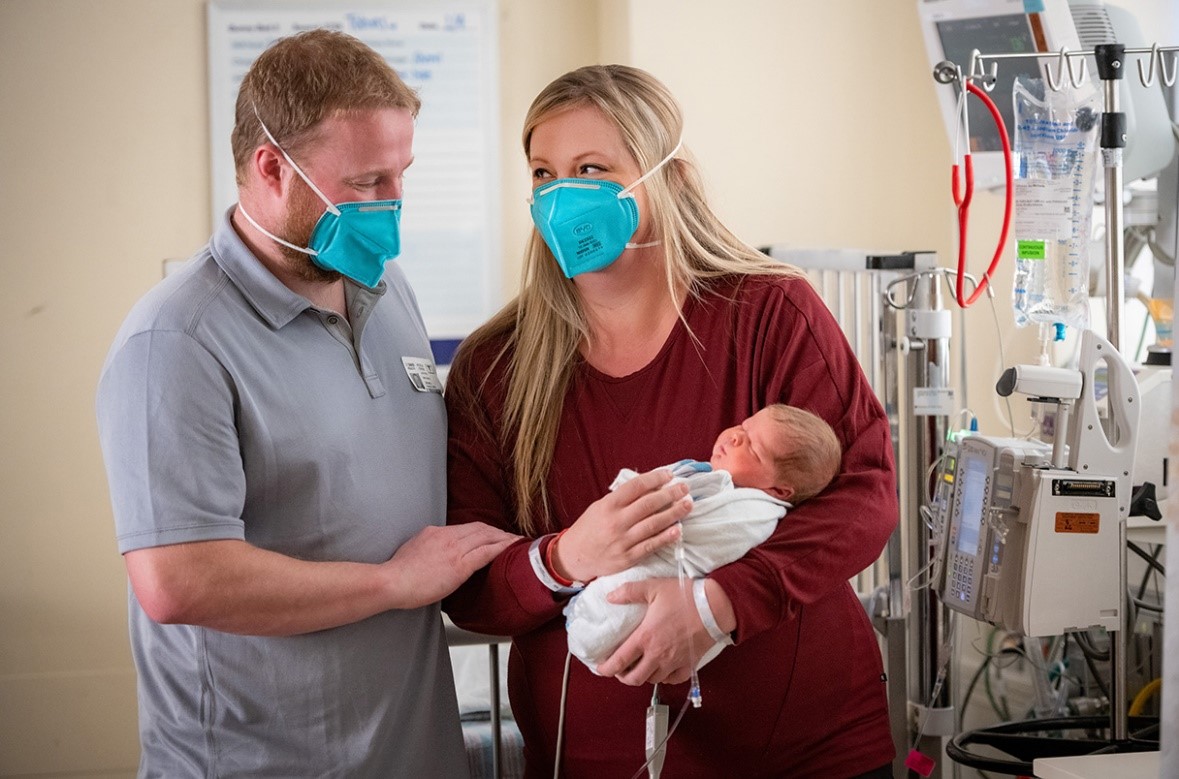
Tobi, shown here with parents Michelle Johnson (right) and Jeff Maginnis, was one of six children given an experimental stem cell therapy for spina bifida before birth.
When Michelle Johnson learned about a trial testing the safety of an experimental treatment for severe spina bifida, the Oregon mom leapt at the chance for her unborn baby to be involved. The condition-in which part of an infant’s spinal cord protrudes from a wound in their back, leading to lifelong disability-had been revealed in her 20-week ultrasound appointment, and she and her partner Jeff Maginnis had been racing to understand their options. The trial would supplement fetal surgery to close the wound, the gold-standard treatment for severe spina bifida, with a dose of stem cells that may help it repair better, a combination that had proved successful over years of animal studies.
Joining the trial would mean moving to another U.S. state and significant disruption to their lives, but “it was just such a rare opportunity,” Johnson says. “To have that available for us was unbelievable.” Now 4 years old, their son Tobi appears healthy. And he is one of six children whose data are included in a study published today in The Lancet showing the approach doesn’t have short-term harmful side effects and doesn’t interfere with the benefits of surgery alone. Researchers have already started to expand the trial to enroll more pregnant women with the same diagnosis.

Tobi, now 4 years old, can walk and run normally despite being diagnosed with spina bifida in the womb, his mom says
Researchers not associated with the trial say the research is an exciting step toward better treatment for spina bifida, and a milestone for efforts to use in utero stem cell treatments for birth defects more generally. “There has been a steady body of evidence building behind this first-in-human trial” for spina bifida, says Gabriel Galea, a biomedical scientist at University College London. He cautions that the safety data are limited to a short time after birth, so longer term follow-ups are needed.
Spina bifida is known as a neural tube defect, in which the embryonic spine or spinal cord doesn’t form properly in the womb. Although many of these defects can be prevented by taking folic acid supplements before and during pregnancy, they still affect some half a million babies around the world each year. In myelomeningocele, the severest form of spina bifida, there’s buildup of fluid in the newborn’s brain and progressive spinal cord damage, causing neurological and mobility problems as well as bowel and bladder issues such as constipation and incontinence.
In the past, surgery to enclose the exposed spinal cord was performed after birth, but a landmark study in 2011 showed significant benefits of carrying out the procedure in utero. The majority of treated children nevertheless faced major challenges-more than half still couldn’t walk independently by 2.5 years old, for example.
The regenerative properties of stem cells may help repair the surgically closed wound in the spine and prevent further damage to the fetus during development. They’re already being studied as in utero treatments for other conditions including the genetic blood disorder thalassemia and osteogenesis imperfecta (OI), or brittle bone disease, though none are yet approved. OI researchers recently presented trial data showing reductions in bone fractures in children with the condition who received stem cells in utero. (Study coordinator Cecilia Götherström of the Karolinska Institute says the team is finishing its analyses and hopes to publish full results soon.)
The spina bifida trial, led by University of California, Davis pediatric surgeon Diana Farmer and biomedical scientist Aijun Wang, involves placenta-derived mesenchymal stem cells (PMSCs), which are generated from donated placental tissue. They and colleagues had previously shown that in a lab dish, these cells can protect neurons from injury and prompt their growth. In unborn lambs, they tested the effect of PMSCs embedded in a patch that includes a matrix of the proteins and other molecules surrounding normal cells. Adding the patch directly onto a spinal wound during reparative surgery helped protect neurons and reduced problems with mobility after birth, they found.
For the new trial, launched in 2021, Wang, Farmer, and their team enrolled six women who were between 24 and 26 weeks pregnant and whose unborn babies were diagnosed with severe spina bifida. Clinicians added a PMSC patch onto the exposed spinal cord of each fetus before closing up the wound. After each child was born by cesarean section, researchers checked for complications, including leaking of cerebrospinal fluid into tissues surrounding the spine, evidence of infection, problems with wound healing, and tumor formation-a concern with treatments involving stem cells.
“We didn’t see any significant adverse effects in any way,” Wang says. In each case, “the baby is doing good. The mom is doing good. And the treatment … didn’t interfere with the expected fetal surgery-only benefits.”
David Chitayat, a medical geneticist at Mount Sinai Hospital, says the results are promising, though he wants to see more data. He wonders whether the stem cells could be inserted with a less invasive type of surgery. In the technique used in this study, clinicians cut open the uterus, but newer approaches to spina bifida repair send tiny cameras and instruments through small incisions. (Wang says his group is already looking into this option.)
With so few patients and such a short follow-up, it’s not yet clear whether the addition of stem cells had benefits over the surgery alone, or whether there could be longer term side effects of the stem cell treatment. The second part of the trial aims to analyze outcomes for 35 children, 19 of whom have already received treatment, says Wang, who is named as co-inventor along with Farmer on multiple patents related to the technology. The study will continue to monitor any safety issues until children are 6 years old, and will also evaluate effects on mobility and bowel and bladder function compared with typical outcomes after surgery. Galea notes that assessing the full effects will take much longer: Spina bifida is associated with predisposition to kidney disease, certain cancers, and other health issues that emerge in adulthood.
Johnson and Maginnis, for their part, feel grateful to have been involved. Tobi walks-and runs-as if nothing had happened, Johnson says. “He has a very vivacious personality-he’s the boss of everyone at our house.” The family is now dedicated to raising awareness of the procedure, she adds. “I hope that this medical advancement becomes available for everyone.”
Source: Science
Link: https://www.science.org/content/article/treating-fetuses-stem-cells-proves-safe-milestone-spina-bifida-trial