Cureus, 04/28/2026
A newly published clinical study has introduced a novel multimodal therapeutic approach, offering new hope for comprehensive aesthetic and functional recovery in patients suffering from severe hypertrophic burn scars.
Clinical Challenge
Hypertrophic scars following thermal burns significantly impair patients’ quality of life due to abnormal collagen overproduction and persistent inflammation, leading to itching, pain, contracture, and cosmetic disfigurement. Although fractional laser therapy is currently considered the gold standard for scar management, the use of high-energy laser treatment on deep scars carries substantial risks of epidermal injury and post-inflammatory hyperpigmentation (PIH), particularly in individuals with darker skin types (Fitzpatrick type IV).
A Breakthrough Solution: Combining Physical Remodeling and Cellular Biology
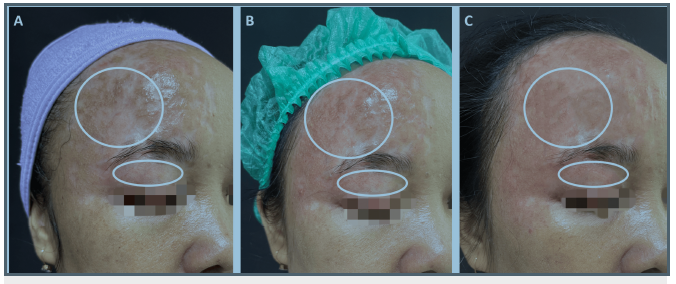
To address this challenge, physicians at General Soedirman Central Military Hospital (Jakarta, Indonesia), in collaboration with international researchers, successfully implemented a two-stage combination protocol in a 46-year-old female patient presenting with hypertrophic scars on the forehead and upper eyelid caused by a hot oil burn.
- Physical Structural Remodeling Using Dual-Wavelength Laser Therapy
A 1550 nm non-ablative fractional laser was first applied to create controlled microscopic thermal injury zones within the epidermis and dermis, stimulating collagen remodeling and flattening the scar surface.
Immediately afterward, a 577 nm yellow laser was administered to selectively target abnormal proliferating blood vessels, thereby reducing erythema and vascular inflammatory responses.
- Biological Regeneration Activated by Exosomes
Following laser treatment, the patient received topical administration of a solution containing 1.1 × 10¹⁰ exosome particles derived from umbilical cord mesenchymal stem cells (UCMSC-exosomes). This was combined with superficial microneedling (0.75 mm depth) to enhance transdermal delivery into deeper skin layers.
Remarkable Clinical Outcomes
After only two treatment sessions spaced one month apart, the patient demonstrated substantial clinical improvement based on the Vancouver Scar Scale (VSS):
Complete Resolution of Symptoms
The patient no longer experienced pain, burning sensation, itching, or scar contracture.
Significant Improvement in Scar Structure and Pigmentation
The VSS score dramatically decreased from 7–9 points to only 2–4 points. The scar became nearly flat, scar tissue softened considerably, elasticity improved markedly, and skin color blended naturally with the surrounding healthy tissue.
Excellent Safety Profile
No adverse events were observed throughout the treatment period. Importantly, no post-inflammatory hyperpigmentation (PIH) developed, likely due to the potent anti-inflammatory and protective effects of exosomes.
Potential Biological Mechanisms of UCMSC-Exosomes
Proteomic and miRNA microarray analyses revealed that umbilical cord-derived exosomes contain several key bioactive molecules, including:
- NT5E/CD73,
- miR-21,
- fibroblast growth factor (FGF),
- hepatocyte growth factor (HGF),
- transforming growth factor-beta (TGF-β),
- and Decorin.
These molecules function as a coordinated biological regulatory system capable of:
- suppressing major inflammatory signaling pathways such as NF-kB and IL-6/JAK/STAT,
- modulating fibroblast activity to prevent excessive collagen deposition and fibrosis,
- promoting controlled wound healing,
- and supporting healthy angiogenesis and tissue regeneration.
Conclusion
This study lays the foundation for a future trend in biologically integrated aesthetic medicine, demonstrating that exosomes are not merely adjunctive agents that enhance the efficacy of advanced laser technologies, but also act as a “biological shield” protecting the skin from thermal-induced side effects.
However, the authors emphasize that larger randomized controlled clinical trials are still required to standardize treatment protocols and confirm long-term efficacy and safety.
References
Pamela, R., Kang, C. C., Lien, L., Lee, G., & Yi, K. (2026). Umbilical Cord Mesenchymal Stem Cell-Derived Exosome-Mediated Regeneration in Hypertrophic Burn Scars Treated With Dual-Wavelength Laser: A Case Report. Cureus, 18(4).
Source: Cureus