eJHaem, 28/09/2026
Background
Cerebral x-linked adrenoleukodystrophy (CALD) is a rare genetic disorder caused by mutations in the ABCD1 gene, leading to accumulation of very long chain fatty acids (VLCFAs), oxidative stress, neuroinflammation, and progressive loss of cerebral glia and myelinated axons, ultimately resulting in fatal neurologic decline. Allogeneic hematopoietic cell transplantation (HCT) can halt cellular degeneration, decrease inflammation, and preserve myelination by replacement of microglial cells. Gene therapy (GT), although recently approved for use, is limited to younger patients with low neurologic functional scores (NFS). Barriers to HCT include carrier status in female family members and lack of suitable human-leukocyte-antigen (HLA) matched donors. Umbilical cord blood (UCB) allows more HLA mismatching due to lower incidence of graft-versus-host disease (GVHD) but is limited by cell dose. A minimum total nucleated count (TNC) of 3 × 10⁷/kg post-thaw is recommended for UCBT in immune competent disorders to reduce graft rejection (GR), delayed engraftment, poor immune reconstitution, and infections. Higher cell doses in HLA-mismatched products have significantly better outcomes at doses up to 6 × 10⁷/kg. Ex-vivo expanded UCB products can overcome cell dose limitations. Omisirge (Omidubicel) is the first such product approved for hematologic malignancies and aplastic anemia. We describe successful HCT with Omisirge in an adolescent with CALD ineligible for GT by age and without suitable donors.
Case Description
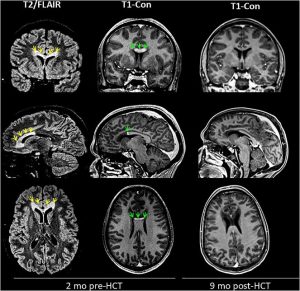
An 18-year-old male with scholastic and behavioral concerns was diagnosed with an ABCD1 pathogenic mutation (c.901-1G>A; Splice acceptor). His NFS was zero. Brain imaging demonstrated T2/FLAIR hyperintensities in the genu of the corpus callosum and bilateral frontal periventricular white matter with associated contrast enhancement in the genu consistent with the frontal variant of CALD and a Loes severity score of 4 (Figure 1). Frontal variant CALD is associated with poor neurologic outcomes despite HCT at Loes scores ≥ 4, unlike the classic variety where scores < 9 have favorable outcomes. This unknown track of progression was extensively discussed with the patient and family in addition to the goals of stemming further deterioration. They favored proceeding with HCT.
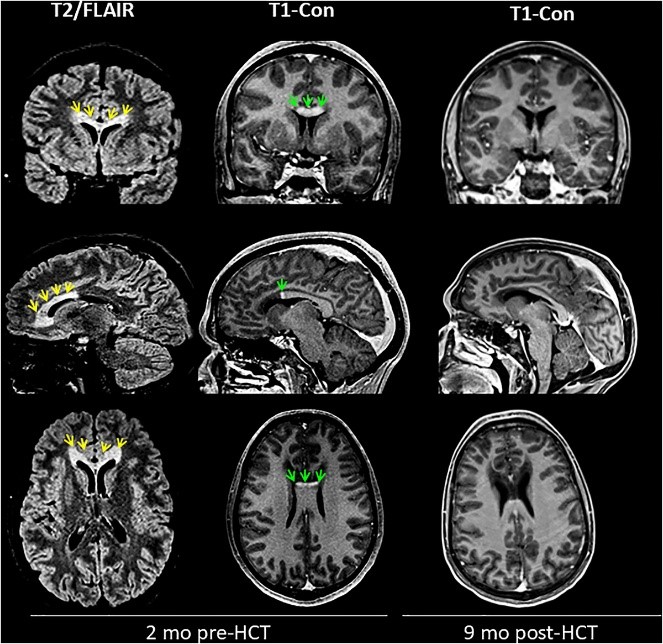
Figure 1. T2/FLAIR and T1 contrast (T1-Con) coronal, sagittal, and axial MR sequences demonstrating T2/FLAIR hyperintensities involving the genu of the corpus callosum with associated atrophy as well as the bilateral frontal white matter (yellow arrows) accompanied by contrast enhancement (green arrows) followed by subsequent resolution of contrast enhancement 9 months post hematopoietic cell transplantation (HCT).
All available familial donors (mother and four siblings) carried the ABCD1 mutation; no suitable registry donors were available. A single 8/10 HLA-matched UCB unit (B and DPB1 allele mismatched) with low pre-thaw TNC and CD34+ cell doses (3.64 × 10⁷/kg and 1.8 × 10⁵/kg, respectively) was identified. The low cell dose prompted compassionate use expansion by Gamida Cell (Kiryat Gat 82584120, Israel).
Hematopoietic stem cells were cultured with nicotinamide to inhibit differentiation and enhance function (homing/engraftment). The product included expanded CD133+ (cultured) and non-expanded CD133− (non-cultured) fractions. The final TNC, CD34+ and CD3+ cell doses infused were 37, 4.31, and 4.0 × 10⁶/kg respectively. The CD34+ cell dose infused was 24-fold higher than the original product.
Following institutional review board approved consent, myeloablative conditioning administered included intravenous busulfan on Days −6 through −3 (target area under the curve 70–90 mg·h/L), fludarabine 30 mg/m2 every 24 h on Days −6 through −3, and thiotepa 5 mg/kg/dose every 12 h on Day −2. Planned GVHD prophylaxis included oral tacrolimus (target trough 8–12 ng/mL), mycophenolate mofetil 17 mg/kg thrice daily through Day +30, and intravenous abatacept 10 mg/kg/dose on Days −1, +5, +28, +60, and +100 per institutional practice. Abatacept doses were extended to include Days +128, +149, and +184 due to patient non-compliance with oral tacrolimus.
Neutrophils (> 500/mm3) and platelets (> 20,000/mm3) engrafted on Days +16 and +56, respectively. Eltrombopag was administered between Days +18 and +38 for thrombocytopenia-induced hematuria and gastrointestinal bleeding. Late acute Grade 1 (skin) and limited chronic GVHD (ocular) were diagnosed on Day +140. Skin biopsy demonstrated spongiotic dermatitis. Following complete resolution of GVHD (Day +211), tacrolimus was discontinued on Day +330.
Stable and full donor myeloid engraftment (> 95% donor CD15+ chimerism) was maintained at 3 and 12 months. Peroxisomal VLCFA (C26:0/C22:0) ratios were 0.042, 0.03, and 0.029 pre-HCT and at 3 and 12 months post-HCT, respectively (normal ≤ 0.023). At 18 months post-HCT, he is employed (since 1-year post-HCT), neurologic examination is normal, all medications are discontinued, and immunizations resumed. Absolute CD4+ T-cell counts were 141 and 252 cells/µL at 6 and 12 months, respectively. MRI (Days +100 and +265) showed near complete resolution of contrast enhancement at the anterior corpus callosum (Figure 1). The Loes score remains unchanged at four. Neurocognitive assessment (Day +79) identified mild attenuation of attention/executive functions, processing, reading, math, and writing speed. This involvement identified early posttransplant without acute HCT-related events is consistent with the radiologic involvement noted from CALD and will be tracked over time. The NFS has remained zero. His Karnofsky performance score is 100.
Discussion
Adolescents with the frontal variant of CALD typically experience rapidly progressive cognitive decline, prominent psychiatric manifestations, motor dysfunction, and cerebellar ataxia, leading to disability and death approximately 2 years after symptom onset. Spontaneous arrest of CALD lesions has rarely been reported. HCT remains the standard treatment for ALD when the Loes score is low; lower Loes and NFS scores predict better treatment outcomes. Successful donor myeloid engraftment is associated with reduced gadolinium enhancement on MRI and disease stabilization, highlighting the importance of early HCT and effective myeloid reconstitution.
Umbilical cord blood transplantation (UCBT) is a viable option for young patients with CALD when no suitable family or registry-matched donor is available, owing to the rapid availability of cells and less stringent HLA-matching requirements. However, low cell dose and the risk of graft rejection (GR) remain challenges, particularly in older patients. UCB cell expansion may overcome this limitation.
Omidubicel, a nicotinamide-expanded UCB product, is the only expanded product approved for patients aged 12 years and older with hematologic malignancies and those aged 6 years and older with severe aplastic anemia. Omidubicel shortens engraftment time, reduces grade 2–3 bacterial infections, shortens hospital stays, and achieves survival rates comparable to those of other stem cell sources. However, this product has been associated with an increased risk of GVHD, as observed in patients with sickle cell disease. The authors’ experience suggests that this risk may be mitigated by abatacept without adversely affecting engraftment. A company-sponsored study in non-malignant diseases is under consideration.
This is the first report of successful HCT using expanded UCB in an adolescent patient with a metabolic disease. The risk of GVHD was successfully controlled by combining abatacept with standard GVHD prophylaxis; timely immune recovery enabled revaccination. This approach warrants further investigation as a stem cell source for transplantation in patients with metabolic diseases.
References
- E. Granberg, T. Pfeiffer, S. Sansar, R. Galindo, and S. Shenoy, Expanded Umbilical Cord Blood Transplantation in Cerebral X-Linked Adrenoleukodystrophy: A Case Report. eJHaem 7, no. 5 (2026): e70419.
Source: eJHaem
Link: https://onlinelibrary.wiley.com/doi/full/10.1002/jha2.70419